
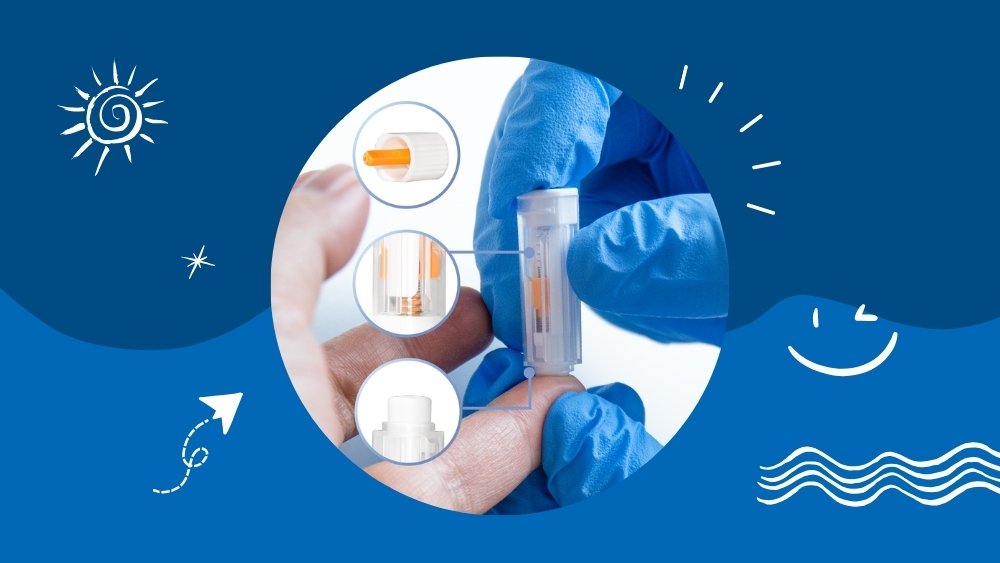
If you have Type 1 or Type 2 diabetes, regular blood sugar testing often means frequent finger pricks. A safety lancet is designed to make blood sampling quick, safe, and reliable while helping reduce accidental needle sticks. This guide explains what a safety lancet is, how it works, and how to choose the right one.
What Are Safety Lancets?

A safety lancet is a compact, all-in-one fingerstick device: sterile, single-use, and self-contained. Press the trigger or push-button, and the blade extends just far enough to puncture the skin before retracting permanently into the housing. No separate device is needed to fire it, and once used, the mechanism locks so the blade can't be exposed again.
The CDC specifically recommends selecting single-use lancets that permanently retract upon puncture as an added layer of protection for both the person testing and anyone who later handles the used device.
Safety Lancets vs. Standard Lancets

A standard lancet is a small blade or needle that loads into a separate, reusable lancing device — a pen-style holder you cock and fire manually each time. The lancet itself is meant for one use, but the pen gets reused across many lancets over weeks or months.
A safety lancet skips the separate holder entirely. The firing mechanism, blade, and housing are all one disposable unit. There's nothing to load, reset, or reuse, and the blade is only exposed for the fraction of a second it takes to puncture the skin. This makes safety lancets a common choice in clinical and assisted-care settings, and an increasingly popular one for home testing too.
Why the Auto-Retract Feature Matters
The Needlestick Safety and Prevention Act of 2000 requires healthcare employers to evaluate and use safety-engineered sharps devices, including retractable lancets, to reduce needlestick injuries in occupational settings. The FDA's guidance on blood lancet labeling goes further, noting that shared or reused lancets have been linked to documented hepatitis B outbreaks in long-term-care settings, which is why manufacturers are directed to label these devices for single-patient use only.
At home, the stakes are smaller but not zero: a retracted, locked blade is simply safer to handle and dispose of than an exposed one, especially in households with kids or anyone else who might come across a used lancet in the trash.
How to Buy Diabetic Lancets
Lancets are sized by gauge, and the numbering is counterintuitive: a higher gauge means a thinner needle. Common options run from 28G (thicker, better for callused skin or when you need a larger blood drop) to 33G (thinner, generally more comfortable for frequent testers).
But gauge isn't the whole story — a study comparing three lancing devices found that puncture depth affected blood volume and pain more consistently than needle gauge did, so a device with adjustable depth settings is often worth more than chasing the thinnest available needle.
You don't need a prescription to buy diabetic lancets; they're sold over the counter at pharmacies and online, and a prescription only matters if you're trying to run the purchase through insurance. Since they're single-use, most people buy in boxes of 100 or more to avoid running out. Sensifine's own safety lancets follow the same sterile, single-use, retractable design covered here — a straightforward option if you're ready to restock.

FAQ
Are safety lancets more painful than regular lancets?
Not inherently. Studies comparing different lancing devices have found no significant differences in perceived pain among common gauge sizes (28G, 30G, and 33G); puncture depth settings and device design have a more critical impact on pain than the needle gauge alone. Of course, individual pain perception also varies.
Can a safety lancet be reused?
No. The auto-retract and lock mechanism is designed to prevent a second firing. Reusing any lancet, safety-engineered or not, raises infection risk and produces a duller, more painful puncture.
Do safety lancets require additional lancing devices to be used?
Of course, no additional devices are needed. The safety lancet is a compact, all-in-one fingerstick device: sterile, disposable, and self-contained. It does not require a separate launching device, and the mechanism locks after use, ensuring that the needle is no longer exposed and cannot be reused.
Do I need a prescription to buy diabetic lancets?
No. Lancets, including safety lancets, are available over the counter without a prescription. You'd only need one if you want the purchase covered by insurance.
How should I dispose of used safety lancets?
Drop them straight into an FDA-cleared sharps container, never loose in household trash. FDA labeling guidance for blood lancets specifically calls for clear disposal instructions on the packaging, so check the box if you're unsure, and follow your local sharps disposal or mail-back program once the container is full.
Disclaimer: This article is for educational purposes only and should not replace professional medical advice. Individual needs vary between people with diabetes. Always consult your diabetes care team with questions about your testing routine or supplies.
References:
- Centers for Disease Control and Prevention. Considerations for Blood Glucose Monitoring and Insulin Administration. Injection Safety, CDC. https://www.cdc.gov/injection-safety/hcp/infection-control/index.html
- U.S. Food and Drug Administration. Blood Lancet Labeling: Guidance for Industry and Food and Drug Administration Staff. fda.gov. https://www.fda.gov/regulatory-information/search-fda-guidance-documents/blood-lancet-labeling-guidance-industry-and-food-and-drug-administration-staff
- Centers for Disease Control and Prevention, NIOSH. Preventing Needlesticks and Sharps Injuries: Reflecting on the 20th Anniversary of the Needlestick Safety and Prevention Act. NIOSH Science Bulletin, 2020. https://www.cdc.gov/niosh/bulletin/2020/sharps-injuries.html
- Mianowska, B., Mlynarski, W., Szadkowska, I., & Szadkowska, A. (2021). Evaluation of three lancing devices: What do blood volume and lancing pain depend on? Journal of Diabetes Science and Technology, 15(5), 1076–1083. https://doi.org/10.1177/1932296820949930
- GoodRx. How to Get a Free Glucose Meter (Glucometer). goodrx.com. https://www.goodrx.com/conditions/diabetes-type-2/how-to-get-a-free-blood-glucose-meter


Leave a comment
All comments are moderated before being published.
This site is protected by hCaptcha and the hCaptcha Privacy Policy and Terms of Service apply.